ICSE Class 9 Syllabus 2026-27
Complete Subject-Wise Guide with PDF Downloads
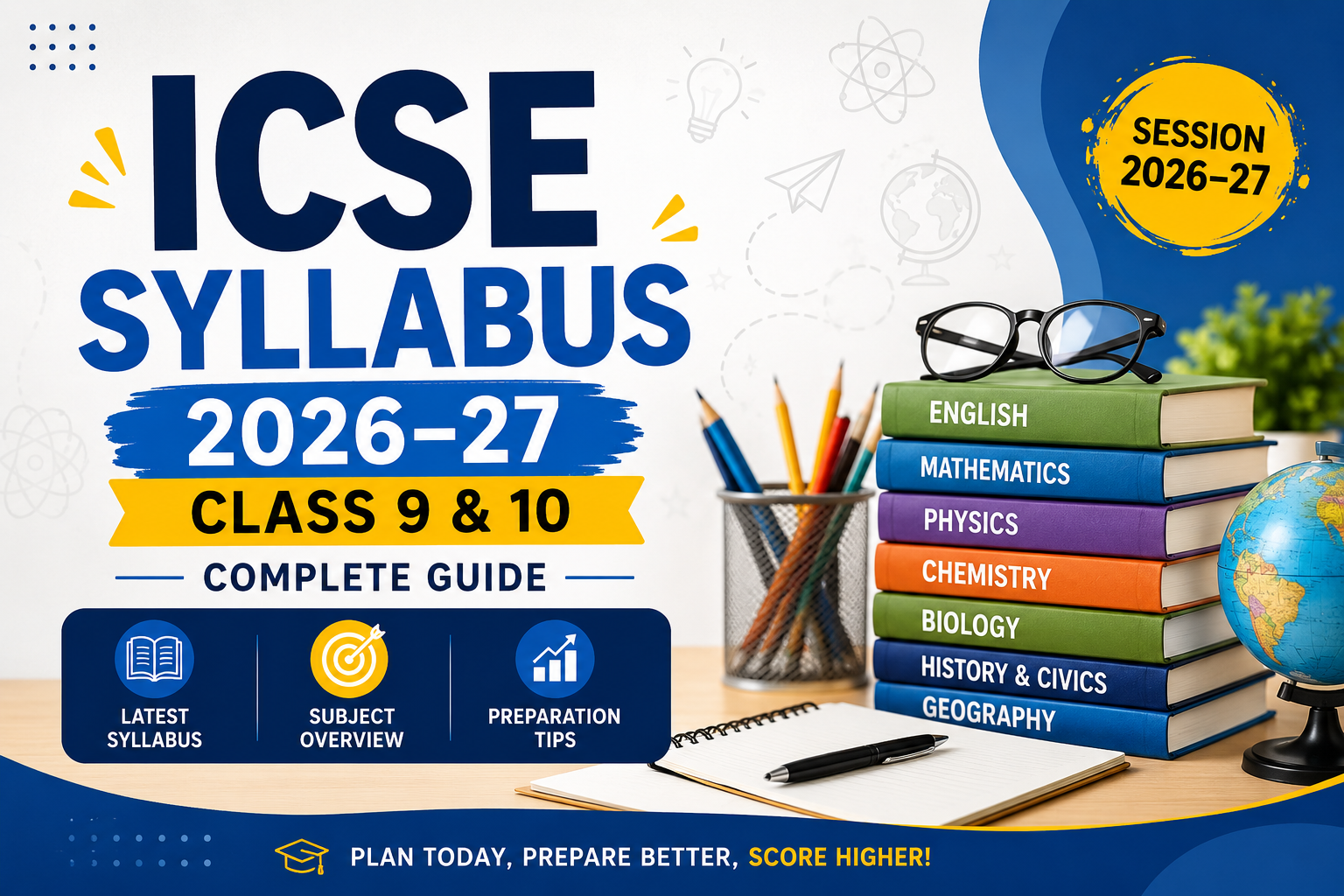
Welcome to the ICSE Class 9 Syllabus 2026-27 page by Learning Lab. Here you can find the Class 9 ICSE syllabus arranged subject-wise, along with downloadable PDF resources for easy access and revision.
Class 9 is an important stage for ICSE students. The syllabus becomes more detailed compared with previous classes, and students need to focus on understanding concepts, practising questions and maintaining regular revision.
The syllabus covered on this page follows the ICSE Examination Year 2027 curriculum referred to in the source material. Students should also check the syllabus and subject combination followed by their individual school.
📥 Download Complete ICSE Class 9 Syllabus PDF
PDF Link: [PASTE COMPLETE ICSE CLASS 9 SYLLABUS PDF LINK HERE]
ICSE Class 9 Subjects 2026-27
The main subjects generally include:
- English
- Second Language
- History & Civics
- Geography
- Mathematics
- Physics
- Chemistry
- Biology
- Computer Applications or another elective subject
The exact subject combination may vary from one school to another.
ICSE Class 9 English Syllabus 2026-27
English consists of two major areas:
- English Language
- Literature in English
📥 Download ICSE Class 9 English Syllabus PDF
PDF Link: [PASTE ENGLISH SYLLABUS PDF LINK HERE]
ICSE Class 9 English Language
Students work on various language and writing skills, including:
- Composition
- Letter Writing
- Comprehension
- Grammar
- Vocabulary
- Sentence Construction
- Summary and other language skills
Regular reading and writing practice can help students develop their English language skills.
ICSE Class 9 Literature in English
Drama
Julius Caesar – William Shakespeare
For Class IX:
- Acts I & II
Prose – Treasure Chest
The Class IX short stories include:
- With the Photographer – Stephen Leacock
- The Elevator – William Sleator
- The Girl Who Can – Ama Ata Aidoo
- The Pedestrian – Ray Bradbury
- The Last Lesson – Alphonse Daudet
Poetry
The Class IX poems include:
- Haunted Houses – H. W. Longfellow
- The Glove and the Lions – Leigh Hunt
- When Great Trees Fall – Maya Angelou
- A Considerable Speck – Robert Frost
- The Power of Music – Sukumar Ray
These are the Class IX texts identified in the source material for Examination Year 2027.
ICSE Class 9 Mathematics Syllabus 2026-27
Mathematics becomes more detailed in Class 9. Students should focus on understanding concepts instead of relying only on memorisation.
📥 Download ICSE Class 9 Mathematics Syllabus PDF
PDF Link: [PASTE MATHEMATICS SYLLABUS PDF LINK HERE]
Important Topics
Arithmetic
- Rational and irrational numbers
- Surds
- Rationalisation
Commercial Mathematics
- Compound Interest
- Amount
- Principal
- Rate
- Growth and depreciation
- Simple Interest and Compound Interest
Algebra
- Algebraic expressions
- Factorisation
- Linear equations
- Indices
- Expansions and identities
Geometry
- Triangles
- Quadrilaterals
- Circles
- Theorems
- Constructions
Mensuration and Statistics
- Area and perimeter
- Surface area and volume
- Data handling
- Graphical representation
- Statistical concepts
Regular practice is important because Mathematics requires continuous problem-solving.
ICSE Class 9 Physics Syllabus 2026-27
Physics introduces students to fundamental concepts of physical science.
📥 Download ICSE Class 9 Physics Syllabus PDF
PDF Link: [PASTE PHYSICS SYLLABUS PDF LINK HERE]
Important Topics
Measurements and Experimentation
- Physical quantities
- SI units
- Measurement
- Least count
- Vernier callipers
- Screw gauge
- Simple pendulum
- Experimental work
Motion
- Distance and displacement
- Speed and velocity
- Acceleration
- Uniform and non-uniform motion
- Distance-time graphs
- Velocity-time graphs
- Equations of motion
Students should practise numerical problems along with theory. Graphs, diagrams and experiments are also important.
ICSE Class 9 Chemistry Syllabus 2026-27
Chemistry introduces students to the basic language of Chemistry and different chemical processes.
📥 Download ICSE Class 9 Chemistry Syllabus PDF
PDF Link: [PASTE CHEMISTRY SYLLABUS PDF LINK HERE]
Important Topics
- Symbols and formulae
- Valency
- Chemical equations
- Chemical reactions
- Atomic structure
- Periodic Table
- Water
- Hydrogen
- Atmospheric and environmental chemistry
- Practical work
Students should try to understand chemical reactions and equations rather than simply memorising them.
ICSE Class 9 Biology Syllabus 2026-27
Biology includes definitions, diagrams and biological processes, making regular revision and practice important.
📥 Download ICSE Class 9 Biology Syllabus PDF
PDF Link: [PASTE BIOLOGY SYLLABUS PDF LINK HERE]
Basic Biology
Important areas include:
- Cell as the unit of life
- Cell theory
- Plant and animal cells
- Prokaryotic and eukaryotic cells
- Cell organelles
- Structure and functions of cell components
The syllabus also includes topics related to plants, human biology, classification and other areas of Biology.
Students should practise labelled diagrams and learn the functions of important structures.
ICSE Class 9 History & Civics Syllabus 2026-27
History and Civics covers historical developments as well as the functioning of political institutions.
📥 Download ICSE Class 9 History & Civics Syllabus PDF
PDF Link: [PASTE HISTORY & CIVICS SYLLABUS PDF LINK HERE]
Civics
Important topics include:
- Our Constitution
- Elections
- The State Legislatures
Students should understand the main features, functions and importance of each topic.
History
Students should study:
- Major civilisations and kingdoms
- Important rulers and personalities
- Historical developments
- Religion and culture
- Art and architecture
- Causes and effects of important events
Making short notes can make History easier to revise.
ICSE Class 9 Geography Syllabus 2026-27
Geography includes physical geography, map work and geographical skills.
📥 Download ICSE Class 9 Geography Syllabus PDF
PDF Link: [PASTE GEOGRAPHY SYLLABUS PDF LINK HERE]
Our World
Important topics include:
- Earth as a planet
- Latitudes
- Longitudes
- Geographic grid
- Prime Meridian
- Time zones
- International Date Line
- Calculation of time
- Great Circles
- Rotation and Revolution
- Equinoxes and Solstices
Other areas include:
- Structure of the Earth
- Rocks
- Landforms
- Atmosphere
- Climate
- Natural vegetation
- Other geographical concepts
Map work should be practised throughout the academic year instead of being left until the final months.
ICSE Class 9 Computer Applications Syllabus 2026-27
Computer Applications introduces students to programming and Java.
📥 Download ICSE Class 9 Computer Applications Syllabus PDF
PDF Link: [PASTE COMPUTER APPLICATIONS SYLLABUS PDF LINK HERE]
Important Topics
- Object-oriented programming
- Objects and classes
- Introduction to Java
- Java development environment
- JVM
- Source code and byte code
- Data types
- Variables
- Operators
- Expressions
- Input and output
- Mathematical library methods
- Conditional statements
- Loops
- Basic Java programs
- Computing and ethics
The syllabus also places importance on practical programming and programming assignments.
ICSE Class 9 Internal Assessment
ICSE also gives importance to internal assessment.
It may include:
- Projects
- Practical work
- Assignments
- Other school-based assessments, depending on the subject
📥 Download ICSE Internal Assessment Guidelines PDF
PDF Link: [PASTE INTERNAL ASSESSMENT PDF LINK HERE]
For the examination structure described in the source material, Group I subjects such as English, Second Language and History, Civics & Geography have 80% external examination and 20% internal assessment. Students should therefore pay attention to both examinations and school-based work.
How to Prepare for ICSE Class 9
Class 9 is a good time to develop a consistent study routine.
Here are some useful preparation tips:
- Study a little every day.
- Practise Mathematics regularly.
- Maintain a separate notebook for formulas.
- Practise Science numerical problems.
- Draw and practise Biology diagrams.
- Practise Geography map work.
- Read the English literature books properly.
- Make short notes for History and Civics.
- Complete projects and practical work on time.
- Revise previously studied chapters regularly.
Download ICSE Class 9 Syllabus PDFs
Students can use the links below to access the subject-wise syllabus PDFs.
| Subject | |
|---|---|
| English | [DOWNLOAD PDF] |
| Second Language | [DOWNLOAD PDF] |
| History & Civics | [DOWNLOAD PDF] |
| Geography | [DOWNLOAD PDF] |
| Mathematics | [DOWNLOAD PDF] |
| Physics | [DOWNLOAD PDF] |
| Chemistry | [DOWNLOAD PDF] |
| Biology | [DOWNLOAD PDF] |
| Computer Applications | [DOWNLOAD PDF] |
| Complete Class 9 Syllabus | [DOWNLOAD PDF] |
Tip for LearningLabICSE.com: Make each [DOWNLOAD PDF] button an actual internal link to the PDF hosted on your website rather than linking to an external file-sharing service. Use descriptive link text such as “Download ICSE Class 9 Physics Syllabus PDF” instead of simply “Click Here.”
ICSE Class 9 Study Resources by Learning Lab
Looking for more than just the syllabus?
Learning Lab can provide students with useful ICSE Class 9 learning resources such as:
- ICSE Class 9 Notes
- Chapter-wise Study Material
- Practice Questions
- Previous Year Questions
- Daily Practice Problems
- Mock Tests
- Revision Material
- Subject-wise Learning Resources
Explore Class 9 Resources: [PASTE CLASS 9 RESOURCES PAGE LINK HERE]
Explore ICSE Notes: [PASTE ICSE NOTES PAGE LINK HERE]
Explore ICSE Courses: [PASTE COURSES PAGE LINK HERE]